


Hosting decision
Namecheap and HostGator can both host WordPress, but the smarter 2026 choice depends on renewal cost, support style and whether domains are central to your workflow.
The first-year price is only the beginning. Namecheap leans heavily into domains plus cPanel hosting with comparatively lower renewal economics. HostGator leans more toward hosting support, phone access and bundled hosting workflows. This comparison focuses on what you actually pay and manage after the promotion ends.
Quick answer
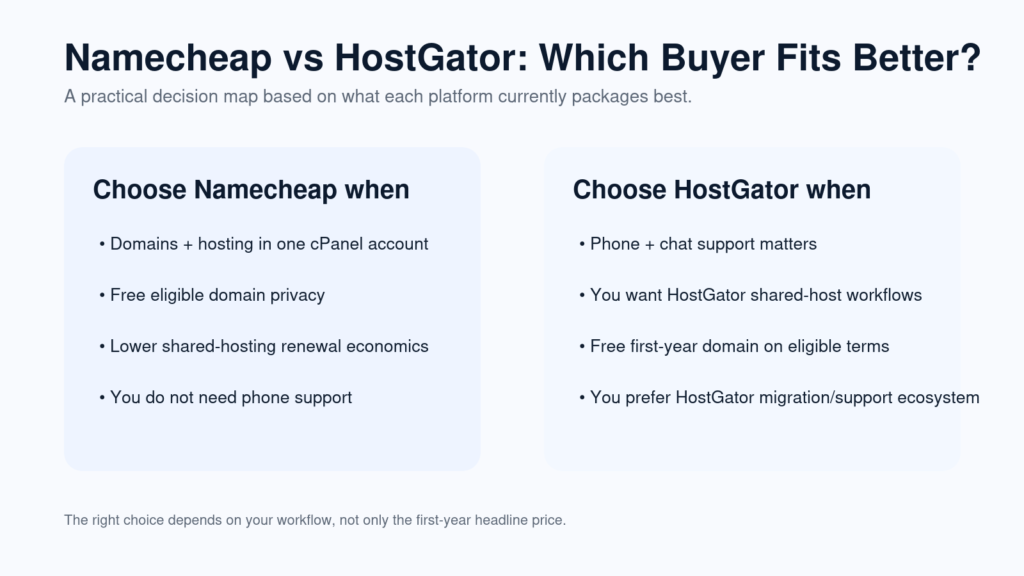
Choose Namecheap if you want lower shared-hosting renewal costs, cPanel, strong domain-management tools and free eligible domain privacy. Choose HostGator if phone support matters, you prefer HostGator’s shared-hosting ecosystem, or its website/domain bundle is more convenient for you. For a domain-heavy portfolio or budget-conscious small site, Namecheap is usually the cleaner value. For a beginner who values phone + chat support and HostGator’s guided hosting environment, HostGator can be easier to live with.
The 2026 buying picture at a glance
Namecheap vs HostGator at a glance
| Decision factor | Namecheap | HostGator |
|---|---|---|
| Shared hosting model | cPanel shared hosting with Stellar plans | cPanel shared hosting with Hatchling, Baby and Business plans |
| Best fit | Domain-heavy users, budget-conscious hosting, cPanel users | Beginners wanting phone + chat support and HostGator workflow |
| Entry shared price | Stellar currently listed from $1.88/mo | Hatchling currently listed from $2.75/mo |
| Renewal transparency | Published current renewal schedule | Published regular price chart |
| Website limits | Stellar 3; Stellar Plus/Business unlimited | Hatchling 1; Baby up to 20; Business up to 50 |
| Control panel | cPanel | cPanel |
| Backups | Manual on all; AutoBackup on Plus/Business | Courtesy server backups; stronger backup control via add-ons |
| Domains | Registrar-first ecosystem; free privacy on eligible domains | Hosting-first bundle; free first-year domain on eligible annual shared plans |
| Phone support | No traditional phone support | Phone + chat support |
For current shared-hosting pricing, compare Namecheap’s official 2026 shared-hosting page with HostGator’s current shared-hosting page. Promotional prices and billing terms can change, so this guide separates the headline offer from renewal economics.
Pricing in 2026: the renewal gap matters more than the first-year price
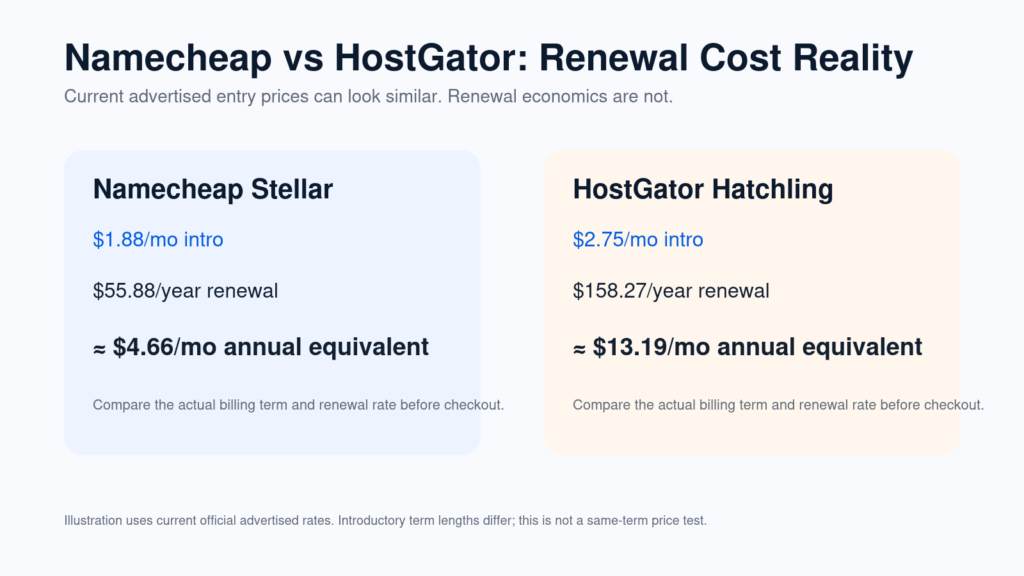
Namecheap currently lists Stellar from $1.88/month, Stellar Plus from $2.28/month and Stellar Business from $4.48/month on its comparison page. More importantly, Namecheap published a May 2026 renewal change: Stellar renews at $55.88/year, Stellar Plus at $85.44/year, and Stellar Business at $128.88/year. See Namecheap’s official renewal notice before buying.
HostGator currently advertises Hatchling from $2.75/month, Baby from $3.95/month and Business from $5.95/month. Its regular-price chart shows that a one-year Hatchling renewal currently works out to $13.19/month, Baby to $18.69/month, and Business to $24.19/month when billed annually. HostGator publishes those regular rates in its hosting price chart.
Annual renewal monthly equivalent for entry shared plans
Report analysis
Why renewal cost changes the recommendation
A hosting plan can look inexpensive at checkout and become a very different budget item after the introductory term. Compare the renewal amount against the actual features you use, not the percentage discount.
- The providers use different promotional terms, so the entry prices are not a perfect same-term experiment.
- For a small site that needs standard cPanel hosting, Namecheap currently has materially lower published annual renewal economics at the entry tier.
- HostGator may still be worth the premium if its phone support, migration ecosystem or plan packaging solves a real operational need.
Do not choose either host from the discount percentage alone
Check the billing term, renewal rate, number of websites, backup method, domain renewal, privacy and any paid security or migration add-ons. A cheaper first invoice can become a more expensive three-year ownership decision.
Shared hosting limits: the old “unlimited websites” comparison is no longer accurate
Namecheap’s current shared-plan documentation lists 3 hosted domains on Stellar, while Stellar Plus and Stellar Business support unlimited hosted domains. The same comparison lists 20 GB SSD for Stellar, unmetered SSD for Stellar Plus and 50 GB SSD for Stellar Business. See Namecheap’s current shared-plan comparison.
HostGator’s current plan documentation has also changed from the old article. Hatchling remains a one-site plan. The current Baby plan documentation describes support for up to 20 websites with 20 GB disk space, while the Business plan documentation describes support for up to 50 websites. That is very different from the old blanket “unlimited sites” claim.
| Current shared-plan factor | Namecheap | HostGator |
|---|---|---|
| Entry plan websites | Stellar: 3 hosted domains | Hatchling: 1 website |
| Mid-tier websites | Stellar Plus: unlimited hosted domains | Baby: up to 20 websites |
| Higher shared tier | Stellar Business: unlimited hosted domains | Business: up to 50 websites |
| Entry storage | Stellar: 20 GB SSD | Check current Hatchling allocation at purchase |
| Mid-tier storage | Stellar Plus: unmetered SSD | Baby: 20 GB disk space in current documentation |
| Bandwidth | Unmetered on current shared plans | Unmetered on shared plans subject to normal use policies |
How to compare “unlimited” hosting without being misled
- 1Website count
Check the explicit website/domain limit on the exact plan, not an old review.
- 2Storage
Unmetered does not mean infinite server resources; hosting policies still impose practical limits.
- 3CPU and memory
Shared hosting performance depends on account resource limits that are not captured by storage numbers alone.
- 4Renewal price
The cost after the introductory term can matter more than the first-year feature table.
Practical verdict
For many small multi-site portfolios, Namecheap currently offers the cleaner shared-hosting value
Stellar Plus combines cPanel, unlimited hosted domains in the current plan table and a materially lower published renewal schedule than HostGator Baby. HostGator remains attractive when its support model or ecosystem is worth paying more for.
WordPress and control panel: both use cPanel, but the surrounding experience differs
Namecheap Shared Hosting currently uses cPanel and includes Softaculous for WordPress/application installs. Its July 2026 getting-started guide also points beginners to Sitejet Builder, email accounts, Zone Editor, backups and malware scanning from the same cPanel environment. See Namecheap’s current Shared Hosting setup guide.
HostGator’s shared platform also centers on cPanel and one-click WordPress installs. Its current Hatchling/Baby documentation bundles WordPress-oriented setup, free SSL and support access around the HostGator Customer Portal plus cPanel. The result is familiar if you already know cPanel, but HostGator’s support and billing layer is more central to the overall experience.
Pros
- Namecheap is attractive if you want domain management and hosting under one company while keeping a conventional cPanel workflow.
- Namecheap exposes Sitejet, Softaculous, email, DNS and backup tools clearly in its current cPanel guide.
- HostGator combines cPanel with phone/chat support, which can reduce friction for non-technical owners who prefer human assistance.
Cons
- Neither provider should be chosen because “cPanel” automatically means identical performance or resource limits.
- HostGator’s higher renewal economics can outweigh the convenience of its support layer for simple sites.
- Namecheap does not provide the same traditional phone-support path as HostGator.
Which cPanel workflow fits you better?
- IfYou manage several domains and want registrar + hosting in one account→Then
Namecheap is the more natural workflow, especially if domain privacy and DNS management are frequent tasks.
- IfYou are new to hosting and want phone support available when cPanel feels confusing→Then
HostGator has the clearer advantage because phone + chat support is part of its service model.
- IfYou already know cPanel and mainly care about long-term shared-hosting cost→Then
Compare Namecheap renewal pricing first; support-channel differences may matter less to you.
- IfYour project is growing beyond ordinary shared hosting→Then
Do not force either shared plan to do VPS/cloud work. Compare the provider’s higher hosting tiers separately.
Backups: the biggest practical difference is how much responsibility stays with you
Namecheap makes the backup model comparatively explicit. All Shared Hosting plans can create manual backups from cPanel, while AutoBackup is available on Stellar Plus and Stellar Business. Its current setup guide also distinguishes ImunifyAV on Stellar/Plus from Imunify360 on Business. Review Namecheap’s current backup and security guidance before deciding which tier you need.
HostGator’s own backup policy is more cautionary: automatic server backups are a courtesy and are not guaranteed, and customers remain responsible for their own data. HostGator documents weekly backup behavior and shared-hosting backup cycles, while recommending stronger independent protection such as CodeGuard for important sites. Read the HostGator backup policy rather than assuming the host’s server copy is your disaster-recovery plan.
Report analysis
A backup is useful only if you can restore the version you need
The question is not “does the host make backups?” The better question is whether you control frequency, retention and restoration when something goes wrong.
- For a brochure site, a host-level safety net plus your own occasional off-site backup may be enough.
- For WooCommerce, membership or frequently changing sites, independent daily backups are much more important than a weekly courtesy copy.
- Never treat hosting backups as the only copy of business-critical content.
Backup questions to answer before buying
- How often will the site change?
- Can you create a backup on demand before updates?
- How many restore points are retained?
- Can you download a copy off the hosting account?
- Does restoration include database, files and email?
- What happens if the hosting account itself is compromised?
Domains: this is where Namecheap has the clearest structural advantage
Namecheap is not merely a hosting company that also sells domains. Domain registration is a core part of its product. Its current .com page lists standard registration and renewal prices separately and includes Domain Privacy free for life on eligible domains. Namecheap’s March 2026 support update confirms that eligible registrations, renewals, transfers and reactivations receive free Domain Privacy by default. See Namecheap’s current .com pricing and Domain Privacy policy.
HostGator also sells domains and includes one free first-year domain with eligible 12-month-or-longer Shared Hosting purchases. Its current domain page lists .com at $12.99 introductory and $22.99 renewal at the time checked. See HostGator’s domain pricing. That can be convenient if you want a simple hosting bundle, but it is not the same registrar-first value proposition as Namecheap.
| Domain factor | Namecheap | HostGator |
|---|---|---|
| Registrar emphasis | Core product and domain-management ecosystem | Domain registration integrated with hosting ecosystem |
| Eligible domain privacy | Free on eligible registrations, renewals, transfers and reactivations | Check current privacy add-on/renewal pricing in HostGator portal |
| .com renewal example checked | Namecheap: $18.48/year | HostGator: $22.99/year |
| Hosting bundle | Hosting can be added separately | Eligible annual Shared Hosting can include first-year domain |
| Best fit | Users managing multiple domains or separating registrar from hosting | Users prioritizing one-company hosting convenience |
Your domain registrar and web host do not have to be the same company
- 1Domain registrar
Owns the registration relationship, renewal, contact data and transfer controls.
- 2DNS provider
Publishes records that point the domain to website, email and other services.
- 3Web host
Stores and serves the website application, database and files.
- 4Email provider
Can be bundled with hosting or completely separate. This separation can improve portability.
For long-term flexibility, do not choose hosting solely because it includes a free first-year domain
A free domain can save a small amount in year one. Registrar usability, renewal pricing, privacy, DNS controls and transfer convenience matter for every year after that.
Uptime guarantees: compare the legal promise, not unsupported speed claims
The old article treated both providers as a simple 99.9% tie, but Namecheap’s current legal page is more nuanced. Stellar, Stellar Plus and Stellar Business are covered by a 100% monthly guarantee, subject to exclusions and a service-cycle prolongation remedy. Namecheap VPS and reseller accounts use a 99.9% guarantee. Read the Namecheap Hosting Uptime Guarantee for the exact scope and exclusions.
HostGator publishes its own plan and service terms, but an uptime guarantee is not the same as independently measured performance. I would not rank either provider from invented “average response time” numbers. Server location, account resource limits, caching, WordPress configuration, plugins and the visitor’s geography can all change real-world speed.
| Performance question | What to verify | Why it matters |
|---|---|---|
| Uptime promise | Read the provider’s current legal/plan terms | Marketing percentages often have exclusions and credit rules |
| Server response | Test your own site from relevant regions | A generic benchmark may not match your theme, plugins or audience |
| Caching/CDN | Confirm what the exact plan includes | Edge caching can affect international visitor experience |
| Resource limits | Check CPU, memory, processes and inode limits | Shared-hosting limits can matter before storage becomes a problem |
| Monitoring | Use independent uptime monitoring after launch | Your own site data is more useful than a review-site average |
Security, SSL and support: both cover the basics, but HostGator has the phone-support edge
HostGator currently states that all Shared, WordPress and eCommerce hosting plans include free SSL, and its free certificate renews automatically while the domain remains correctly pointed. See HostGator’s current SSL documentation. Namecheap’s shared-hosting cPanel guide documents automatic SSL tooling, malware scanning and two-factor authentication options within the account environment.
Support is a clearer differentiator. Namecheap is built around 24/7 live chat, tickets and its knowledge base. HostGator’s current Shared Hosting documentation advertises phone and chat support. If you are the kind of site owner who wants to call someone when email, DNS or WordPress breaks, HostGator’s phone channel is a real operational advantage.
When support should override the cheaper hosting price
- IfYou are comfortable with cPanel, documentation and live chat→Then
Namecheap’s lower renewal economics are harder to ignore.
- IfYou strongly prefer speaking to support by phone→Then
HostGator has the clearer fit even if the renewal price is higher.
- IfYour site is business-critical and downtime is expensive→Then
Choose based on architecture, backup strategy and escalation quality—not a few dollars of monthly hosting cost.
- IfYou need developer-level server control→Then
Stop comparing entry shared hosting and move the evaluation to VPS/cloud products.
Website migration: Namecheap is more cPanel-transfer-friendly; HostGator now prices many professional migrations separately
Namecheap’s migration team can handle eligible full cPanel-to-cPanel transfers into Shared Hosting after checking plan limits, compatibility and the source host’s ability to generate a full cPanel backup. Its migration documentation also explains manual and WordPress-specific paths. See Namecheap’s hosting migration guide.
HostGator’s current migration documentation is more restrictive than many older reviews suggest. Professional site migration through the Customer Portal can carry a $149.99 one-time fee for a single website, while limited free professional migrations are offered for eligible new VPS and Dedicated customers on qualifying 12-month terms. HostGator also lists email migration separately. Check the current HostGator migration guide before assuming a shared-hosting transfer is free.
Report analysis
Migration cost can erase a cheap first-year hosting deal
If you are moving an existing business site rather than starting from scratch, migration complexity belongs in the total-cost calculation.
- A new blank WordPress site has almost no migration cost.
- A cPanel account with site files, databases and email is easier to transfer when both source and destination support full cPanel backups.
- Email migration, DNS cutover and third-party integrations can remain separate work even when the website itself is migrated.
Migration questions to answer before switching hosts
- Is the source account cPanel, Plesk, proprietary hosting or managed WordPress?
- Does professional migration include email or only website files/database?
- Will DNS be changed by the host or by you?
- Is there a staging/temporary URL to test before cutover?
- Who owns the rollback backup if the migration fails?
- Are forms, cron jobs, SMTP, payment callbacks and DNS records documented?
Which is better for different website owners?
| User type | Better starting choice | Reason |
|---|---|---|
| First personal WordPress site | Namecheap | Lower published renewal economics and familiar cPanel are compelling if live chat is enough. |
| Small business owner who wants phone support | HostGator | Phone + chat support can be worth the higher renewal cost for non-technical owners. |
| Domain investor / multi-domain operator | Namecheap | Registrar-first tooling and free eligible domain privacy are stronger structural advantages. |
| Small agency managing many basic sites | Namecheap Stellar Plus | Current shared plan supports unlimited hosted domains and lower renewal pricing. |
| Owner who wants one-year free domain bundle | HostGator | Eligible annual Shared Hosting terms include a first-year domain. |
| WooCommerce or mission-critical site | Neither entry plan by default | Compare higher-resource managed WordPress, cloud or VPS products and independent backups. |
| Developer needing server control | Neither shared plan | Move the comparison to VPS/cloud infrastructure. |
Pros
- Namecheap: stronger registrar-first ecosystem and free eligible domain privacy.
- Namecheap: lower current published shared-hosting renewal prices at comparable entry tiers.
- Namecheap: conventional cPanel workflow and stronger current multi-site value on Stellar Plus.
- HostGator: phone + chat support for users who want real-time human assistance.
- HostGator: free first-year domain on eligible annual Shared Hosting purchases.
Cons
- Namecheap: no traditional phone support.
- Namecheap: AutoBackup is plan-dependent rather than universal across shared hosting.
- HostGator: current annual renewal costs are materially higher than Namecheap’s entry shared tiers.
- HostGator: server-side backups are described as a courtesy and should not replace your own backup plan.
- HostGator: many professional site migrations are now paid unless you qualify for a limited free VPS/Dedicated transfer.
Practical verdict
My 2026 verdict: Namecheap wins on long-term shared-hosting value; HostGator wins when phone support is a must-have
For a normal WordPress blog, portfolio or small business site, I would start with Namecheap because its current shared-hosting renewal economics, cPanel workflow and registrar tools create a stronger long-term value proposition. I would choose HostGator instead when phone support is genuinely important or when its specific hosting bundle and migration/support ecosystem fits the owner better. Neither should be selected for a high-stakes site without an independent backup and resource plan.
Before checkout, compare the renewal invoice—not the coupon
Open the provider’s current renewal/price chart, add any backup, privacy, email or migration costs you actually need, and calculate the first three years. That number is more useful than “60% off.”
Frequently asked questions
Is Namecheap better than HostGator in 2026?
For many small shared-hosting users, Namecheap currently offers the stronger long-term value because its published annual renewal prices are lower and its registrar tools are excellent. HostGator can be the better fit when phone support and its hosting workflow are more important than renewal cost.
Which is cheaper after renewal, Namecheap or HostGator?
At the current entry shared tiers checked for this guide, Namecheap Stellar renews at $55.88 per year, while HostGator Hatchling’s current one-year regular price is $158.27. Pricing can change, so verify both providers before purchasing.
Does HostGator Baby still allow unlimited websites?
Current HostGator documentation describes the Baby plan as supporting up to 20 websites, not unlimited websites. Older comparison articles may still show the previous product structure.
Does Namecheap include automatic backups?
Namecheap provides manual backup tools across Shared Hosting, while AutoBackup is currently available on Stellar Plus and Stellar Business. You should still maintain an independent copy of important sites.
Does HostGator include free SSL?
Yes. HostGator currently states that Shared, WordPress and eCommerce hosting plans include a free SSL certificate, with automatic renewal while the domain is properly pointed to the account.
Which is better for domain registration?
Namecheap is the stronger registrar-first choice. Eligible domains receive free Domain Privacy, and domain management is a core part of the platform. HostGator is more attractive when you want the domain bundled with hosting.
Which has better customer support?
Both provide online support, but HostGator has the practical advantage for users who want phone support. Namecheap focuses on live chat, tickets and knowledge-base support.
Can I migrate a WordPress site to either provider?
Yes, but the assistance model differs. Namecheap supports eligible cPanel migrations and WordPress transfer paths. HostGator offers migration options, but its current documentation lists a paid professional migration fee for many site transfers and limited free migration for qualifying VPS/Dedicated customers.
Related guides

Hostinger vs Namecheap (2026): Which Is Better for WordPress, Hosting and Domains?
Compare two budget-friendly hosting ecosystems across renewals, WordPress, domains and control panels.

Hostinger vs Cloudways (2026): Which Is Better for WordPress Hosting?
See when simpler integrated hosting makes more sense than managed cloud infrastructure.

Hostinger vs Linode: Find Your Perfect Hosting Match
Explore the trade-off between managed hosting convenience and infrastructure control.
Choosing or moving web hosting?
Use Bloggingfy’s hosting, DNS and migration guides before changing the live site.
Compare renewal cost, backup strategy, migration scope and DNS cutover before you move production.
About the editor
Netranand Meshram
Bloggingfy publishes practical guides for website owners dealing with domains, DNS, WordPress, hosting, migrations and business website infrastructure.